Cleanroom Components Explained: What Actually Determines Compliance
A cleanroom is not one product. It is a system of individual cleanroom components — partitions, doors, furniture, and equipment — that must work together to hold a specific air cleanliness classification day after day. Get one component wrong, and the entire facility can fail an audit, regardless of how well everything else was designed.
This guide breaks down every major category of cleanroom components, explains how each one relates to ISO 14644 cleanroom requirements and GMP cleanroom components standards, and gives you a practical framework for choosing the right systems for a pharmaceutical, healthcare, biotechnology, or electronics manufacturing facility.
1. What Are Cleanroom Components?
Cleanroom components are the individual structural, functional, and equipment elements that together create and maintain a controlled, low-particle environment. This includes modular cleanroom panels for walls and ceilings, cleanroom doors, stainless steel laboratory furniture, HVAC and filtration equipment, and validation instrumentation.
Every cleanroom component has a specific job: containing particles, maintaining pressure, resisting chemical exposure, or enabling airflow management. None of them function independently — a cleanroom's ISO classification is only as strong as its weakest component.
2. Why Compliant Cleanroom Components Matter
Non-compliant components don't just risk a failed audit — they compromise product safety, patient safety, and process reliability. A partition panel with poor seams sheds particles. A door without proper hardware voids its fire rating. Furniture with exposed fasteners traps contaminants that no HVAC system can remove.
Regulatory frameworks like ISO 14644 compliance, GMP compliance, and WHO GMP cleanroom guidelines exist precisely because component-level failures compound into facility-level failures. Choosing GMP cleanroom components isn't a checkbox exercise — it's the foundation of contamination control.
3. Cleanroom Partition Systems
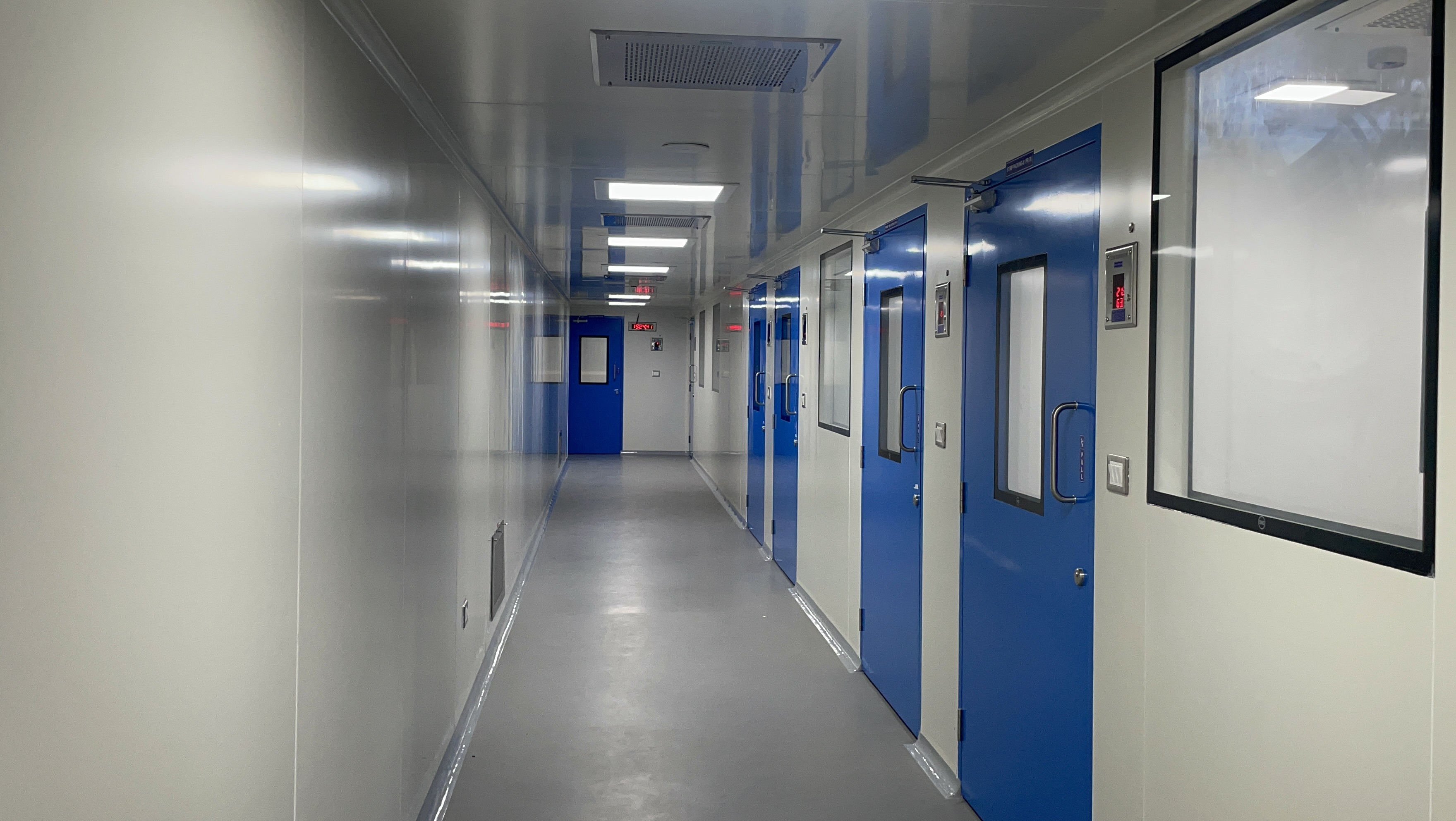
Cleanroom partition systems are the structural backbone of any modular cleanroom facility. They define room boundaries, help maintain pressure differentials, and prevent cross-contamination between zones of different cleanliness grades.
Modern cleanroom partition systems are built from modular cleanroom panels — typically sandwich wall panels with a metal outer skin and an insulating infill core. Panel thickness generally ranges from 30mm (used for cladding only) up to 100mm, with sheet metal gauges from 0.6mm to 1.2mm depending on load, insulation, and fire-rating needs. Infill materials fall into three common categories:
- Puff (polyurethane foam) — density around 42±2 kg/m³, cost-effective and suited to standard temperature-controlled zones
- Rockwool (mineral wool) — density around 96±2 kg/m³, preferred where fire resistance and acoustic insulation matter more
- EPS — used only in non-cleanroom areas due to lower fire performance
Riser panels, a specialized subset of partition systems, conceal utility shafts and service lines within cleanroom walls without compromising the sealed envelope. A complete partition system also includes accessories — H-connectors, floor support U-connectors, suspension hangers, ceiling connectors, and air terminal cutouts — all engineered to eliminate gaps where particles or air leakage could occur.
Checklist: Evaluating a cleanroom partition system
- Panel thickness matched to your target ISO class and thermal requirements
- Infill material selected for fire rating (Rockwool) vs. cost efficiency (Puff)
- PPGI or PCGI finish confirmed as smooth, non-porous, and disinfectant-resistant
- Full accessory kit included (connectors, hangers, cutouts) from a single supplier
- System designed for future reconfiguration or expansion
4. Cleanroom Doors
Cleanroom doors are frequently the weakest link in an otherwise well-designed facility, because a door is a moving, sealing component in a system that depends on staying airtight. Three configurations dominate regulated environments:
- Sliding cleanroom doors — space-efficient, minimal airflow disturbance, ideal for high-traffic corridors
- Swing cleanroom doors — simpler mechanism, easier to seal tightly, available in single or double-leaf configurations
- Interlocked cleanroom doors — used in airlocks and material pass-throughs, where only one door can open at a time to prevent pressure equalization between zones of different classification
Hermetically sealed doors use perimeter seal systems — compression or brush seals — that activate on every closure, maintaining pressure differentials and blocking airborne contamination between rooms. Interlock systems are typically required in ISO Class 5–7 pharmaceutical manufacturing zones and GMP-regulated sterile areas, since simultaneous door openings in an airlock can equalize pressure and pull contaminated air into a clean zone.
Materials matter too: GI (galvanized iron) suits standard classifications cost-effectively, while stainless steel is preferred for high-hygiene pharmaceutical and sterile environments due to superior corrosion resistance. A door's fire rating is only valid with correctly matched hardware — closers, panic bars, hinges, mortise locks, and smoke seals specified for that exact rating class. Swapping in uncertified hardware voids the rating entirely.
5. Cleanroom Furniture
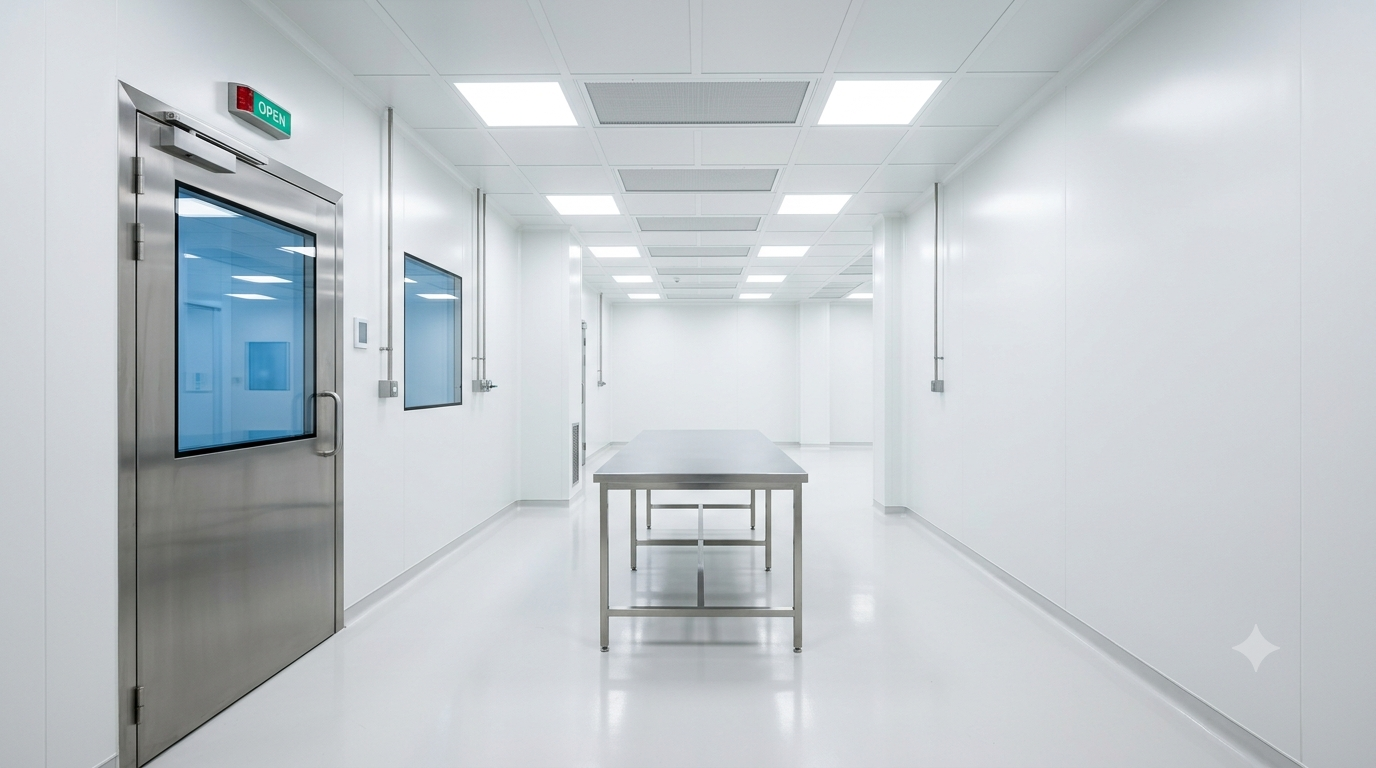
Cleanroom furniture must satisfy two competing demands simultaneously: durability under constant chemical exposure, and zero particle generation. This rules out most standard laboratory or office furniture.
The dominant materials are:
- SS 304 stainless steel — 18% chromium, 8% nickel; resistant to most laboratory chemicals and corrosion, suitable for the majority of pharmaceutical, research, and healthcare environments
- SS 316 stainless steel — adds 2–3% molybdenum, giving markedly better resistance to chlorides, saline solutions, and aggressive solvents; specified for labs handling strong acids or chlorine-based disinfectants
- GI powder-coated steel — a cost-effective option for general research or educational labs with moderate chemical exposure
Common cleanroom furniture categories include island modular laboratory tables (accessible from all four sides, fitted with reagent racks and utility points), stainless steel sink units, lockable storage cabinets, chemical-resistant cabinets with built-in exhaust for hazardous substances, and garment or equipment storage racks. To qualify as cleanroom-compatible, furniture must have smooth, crevice-free surfaces with no exposed fasteners, no hollow structural members that trap uncleanable air pockets, and full resistance to the specific disinfectants used in the facility's validated cleaning protocol.
6. Cleanroom Equipment
Cleanroom equipment covers the operational systems that actively maintain the controlled environment — HVAC units engineered for precise airflow, temperature, and humidity control; HEPA and ULPA filtration assemblies; pressure-cascade control systems; and validation instrumentation such as particle counters, anemometers, and photometers.
Unlike partitions, doors, and furniture, which are largely passive contamination barriers, cleanroom equipment is the active layer that continuously removes particles, sustains pressure differentials, and keeps environmental parameters within specification. A cleanroom equipment manufacturer serving pharma or biotech clients typically also supplies modular operation theatre (OT) equipment for hospitals, where the same principles — sealed surfaces, controlled airflow, infection control — apply to a surgical setting rather than a manufacturing line.
7. Materials Used in Cleanroom Construction
Across partitions, doors, and furniture, material selection follows the same underlying logic: smooth, non-porous, chemical-resistant, and non-particle-shedding.
| Material | Typical Use | Key Property |
|---|---|---|
| PPGI (Pre-Painted Galvanised Iron) | Wall & ceiling panels | Smooth, hygienic, contamination-resistant finish |
| PCGI (Pre-Coated Galvanised Iron) | Custom-finish panels | Alternate surface/colour to spec |
| SS 304 | Furniture, sink units, doors | Corrosion and chemical resistance for most labs |
| SS 316 | High-corrosion furniture, sterile doors | Superior chloride/acid resistance |
| Rockwool infill | Fire-rated partitions | High fire resistance, acoustic insulation |
| Puff (PUF) infill | Standard partitions | Cost-effective thermal insulation |
8. ISO 14644 Cleanroom Requirements
ISO 14644 is the internationally recognized standard family governing cleanroom classification and testing. The most relevant parts for component selection and validation are:
- ISO 14644-1 — defines airborne particle cleanliness classifications from ISO Class 1 (cleanest) through ISO Class 9, based on the maximum permitted concentration of particles at specified sizes per cubic meter of air
- ISO 14644-2 — specifies ongoing monitoring and requalification requirements, generally recommending particle count testing every 6 months for ISO Class 5 and cleaner, and every 12 months for ISO Class 6–8
- ISO 14644-3 — defines the test methods used to validate individual parameters, including filter integrity, particle recovery, and airflow visualization
Every component discussed above — partition seams, door seals, furniture surfaces — exists to help a facility hold its designated ISO class consistently, not just at day-one commissioning.
9. GMP and WHO-GMP Requirements
GMP compliance for cleanrooms is grade-based rather than class-based. WHO-GMP and most national GMP frameworks (including India's Schedule M, Revised) define Grades A, B, C, and D, each with maximum permitted particle counts and microbial limits, both "at rest" and "in operation."
GMP cleanroom components must support this grading system structurally: partition and door systems that maintain the correct pressure cascade between grades, furniture that meets WHO-GMP surface hygiene standards, and equipment capable of sustaining the airflow and filtration performance each grade demands. WHO GMP cleanroom guidance also emphasizes documented validation and periodic requalification — a cleanroom is compliant only if it can prove ongoing performance, not merely initial design intent.
10. Cleanroom Validation
Cleanroom validation is the documented process of confirming a facility performs within its specified parameters — not a one-time event, but a recurring compliance requirement. A comprehensive validation typically covers nine parameters: air velocity, differential pressure, filter integrity (PAO/DOP testing), particle count, particle recovery, airflow pattern (smoke visualization), temperature and humidity, luminous intensity, and sound level.
Commissioning and validation are distinct: commissioning confirms installed systems function as designed; validation provides the standardized, documented evidence — required for NABH, GMP, and ISO audits — that the cleanroom consistently meets its performance specification.
11. Contamination Control, Airflow & Pressure Differential
Contamination control is the overarching goal that every cleanroom component serves. Airflow management — the pattern and velocity at which air moves through a room — determines whether particles are swept away from critical zones or allowed to stagnate and recirculate. Air flow pattern testing using non-toxic smoke tracers is used to confirm unidirectional laminar flow reaches critical work zones without dead spots.
Pressure differential is the mechanism that prevents air (and contaminants) from migrating between zones of different cleanliness grades. In a pharmaceutical facility, the highest-grade sterile zone is held at the highest positive pressure, cascading downward through progressively less-classified areas to the corridor. When a door opens briefly, air should flow outward from the cleaner zone — never the reverse. This is why door seal quality and partition airtightness are inseparable from pressure differential performance.
12. HEPA Filtration & Particle Count Testing
HEPA (and in higher-classification zones, ULPA) filtration is the primary mechanism for removing airborne particles before air enters the cleanroom. Filter integrity is verified through a PAO or DOP aerosol challenge test, where a fine aerosol is introduced upstream of the filter and scanned downstream with a photometer; any point where penetration exceeds 0.01% of the upstream concentration signals a leak requiring repair or filter replacement.
Particle count testing measures airborne particle concentration — typically at 0.5 micron and 5.0 micron sizes — against ISO 14644-1 class limits or GMP grade limits, both at rest and in operation, since human activity is the primary source of particle generation during normal operations. A failed particle count usually traces back to one of three root causes: a filtration issue, a pressure differential problem, or an inadequate air change rate.
13. Comparison Table: Cleanroom Components at a Glance
| Component | Common Materials | Primary Application | Compliance Benefit |
|---|---|---|---|
| Wall & ceiling partition panels | PPGI/PCGI sandwich panels, Puff or Rockwool infill | Defining room boundaries, ISO Class 5–8 zones | Airtightness, pressure retention, fire resistance |
| Riser panels | PPGI sandwich panels, 80–100mm | Concealing utility shafts within cleanroom walls | Maintains envelope integrity around services |
| Sliding/swing cleanroom doors | GI, SS 304/316 | High-traffic and standard access points | Low airflow disturbance, sealed access |
| Interlocked doors | GI, SS with perimeter seals | Airlocks, material pass-throughs | Prevents pressure equalization between zones |
| Laboratory furniture | SS 304, SS 316, GI powder-coated | Workbenches, sinks, storage, chemical cabinets | Non-porous, chemical-resistant, non-particle-shedding |
| HVAC & filtration equipment | HEPA/ULPA media, ducting, AHUs | Airflow, temperature, humidity, pressurization | Sustains ISO/GMP classification continuously |
| Validation instrumentation | Calibrated anemometers, particle counters, photometers | Commissioning and periodic requalification | Documented, audit-ready compliance evidence |
14. Common Mistakes When Selecting Cleanroom Components
Choosing panel infill based on cost alone, without checking fire-rating requirements for the intended ISO class
Installing a fire-rated door with mismatched or uncertified hardware, unknowingly voiding the rating
Specifying standard laboratory furniture with exposed fasteners or hollow legs that trap particles
Treating validation as a one-time commissioning step rather than a recurring ISO 14644-2 and WHO-GMP requirement
Sourcing partitions, doors, and furniture from separate vendors without confirming they integrate into one sealed, pressure-consistent system
Overlooking riser panel integrity, leaving utility penetrations as a hidden source of air leakage
15. How to Choose the Right Cleanroom Components
Start with your target ISO classification or GMP grade — this determines panel thickness, infill type, door configuration, and furniture material grade before anything else. From there:
- Confirm every component (partitions, doors, furniture, equipment) is rated for the same classification, not just individually compliant
- Prioritize a single-vendor or tightly coordinated supply chain to avoid integration gaps between systems
- Request documentation — material certificates, fire ratings, filter integrity data — upfront, not after installation
- Plan for validation and revalidation cycles at the design stage, not as an afterthought
- Choose a cleanroom component supplier or modular cleanroom manufacturer with in-house fabrication, installation, and validation capability, since diagnosing a compliance issue is far faster when one team understands the whole system
16. Industries That Require Compliant Cleanrooms
Compliant cleanroom components are mandatory across:
- Pharmaceutical manufacturing — sterile and non-sterile production, API facilities, packaging zones
- Biotechnology and life sciences — cell culture labs, gene therapy production, genomics research
- Hospitals and healthcare — operation theatres, ICUs, sterile processing units, isolation wards
- Semiconductor and electronics manufacturing — contamination-sensitive assembly and wafer fabrication
- Aerospace and defense — precision component manufacturing and testing
- Food & beverage — controlled processing and packaging environments
17. Future Trends in Modular Cleanroom Technology
Modular cleanroom technology continues to move toward faster deployment and greater flexibility. Prefabricated panel systems that once took weeks to install are increasingly designed for reconfiguration — allowing facilities to expand, shrink, or relocate cleanroom zones as production needs change, without the extensive rework conventional civil construction requires. Expect continued growth in integrated monitoring (continuous pressure and particle sensors feeding directly into compliance documentation systems), greater use of antimicrobial and easy-clean surface coatings, and tighter coordination between component manufacturers and validation teams to shorten the gap between installation and audit-readiness.
Key Takeaways
- A cleanroom's compliance is only as strong as its weakest individual component — partitions, doors, furniture, and equipment must be evaluated as an integrated system, not separately.
- ISO 14644 governs particle-based classification (Class 1–9); GMP and WHO-GMP govern grade-based compliance (Grades A–D) — components must satisfy whichever framework applies.
- Material selection (SS 304 vs. SS 316, Puff vs. Rockwool infill, GI vs. stainless doors) should be driven by chemical exposure, fire rating, and classification needs — not cost alone.
- Validation is recurring, not one-time: ISO 14644-2 and WHO-GMP both require periodic requalification of pressure, particle count, and filtration performance.
- Pressure differential and door seal integrity are directly linked — a compromised door seal undermines the entire facility's contamination control strategy.
Conclusion
Cleanroom components aren't interchangeable commodity parts — they are the specific, interdependent building blocks that determine whether a facility can meet and sustain its ISO 14644 or GMP classification. Partitions define and seal the space; doors control access without breaking pressure integrity; furniture supports operations without generating contamination; and equipment actively maintains the environment day after day. Getting these cleanroom components right — and validated — is what separates a facility that passes its next audit from one that doesn't.
FAQ
What are the essential components of a cleanroom?
The essential components of a cleanroom are partition systems (wall and ceiling panels that define and seal the space), doors (sliding, swing, or interlocked, depending on traffic and pressure requirements), furniture (stainless steel or GI workbenches, sinks, and storage built for chemical resistance and non-particle-shedding), and equipment (HVAC, HEPA/ULPA filtration, and validation instrumentation). Each component plays a distinct role: partitions and doors form the physical envelope and control pressure, furniture supports operations without contaminating the space, and equipment actively maintains airflow, temperature, and filtration. All four must be matched to the same ISO classification or GMP grade to function as a compliant system rather than a collection of individually acceptable parts.
Why are cleanroom partitions important for GMP compliance?
Cleanroom partitions form the structural backbone that maintains pressure differentials and prevents cross-contamination between zones of different cleanliness grades — a core requirement of GMP compliance. Sandwich panel systems with PPGI or PCGI finishes and Puff or Rockwool infill are engineered for airtight seams, smooth non-porous surfaces, and resistance to fire and chemical exposure. Under WHO-GMP and equivalent national frameworks, a facility cannot sustain its designated grade if partition seams leak air or shed particles. Because partitions integrate directly with doors, ceilings, and HVAC systems, their quality directly determines whether the facility can pass both initial commissioning and ongoing revalidation.
How do cleanroom doors help maintain contamination control?
Cleanroom doors maintain contamination control primarily through perimeter sealing systems — compression or brush seals that activate on every closure to preserve pressure differentials between zones. Interlocked doors, used in airlocks and material pass-throughs, ensure only one door opens at a time, preventing pressure equalization that would otherwise pull contaminated air into a cleaner zone. Sliding doors minimize airflow disturbance in high-traffic corridors, while swing doors offer simpler, tighter sealing for standard access points. Because a door is the only actively moving component in an otherwise static envelope, its seal integrity and hardware specification are directly tied to whether the facility maintains its required pressure cascade.
What type of furniture should be used inside a cleanroom?
Cleanroom furniture should be fabricated from SS 304 or SS 316 stainless steel, or GI powder-coated steel for lower-exposure applications, with smooth, crevice-free surfaces and no exposed fasteners or hollow structural members that could trap particles. SS 316 is preferred where chlorides, acids, or aggressive disinfectants are used regularly, while SS 304 suits the majority of pharmaceutical and research environments. Common furniture types include island modular laboratory tables, stainless steel sink units, lockable storage cabinets, and chemical-resistant cabinets with built-in exhaust. All surfaces must withstand the facility's validated disinfection protocol without degrading, since any breakdown in surface integrity becomes a contamination and compliance risk.
Which cleanroom equipment is required for ISO 14644 compliance?
ISO 14644 compliance requires HVAC systems engineered for precise airflow, temperature, and humidity control; HEPA or ULPA filtration assemblies capable of meeting the particle removal efficiency needed for the target ISO class; pressure control systems to maintain the correct cascade between zones; and calibrated validation instrumentation — including particle counters, anemometers, and photometers — used for both commissioning and periodic requalification under ISO 14644-2. Equipment selection depends heavily on the specific ISO class targeted, since higher classifications (ISO Class 5 and below) demand tighter filtration efficiency, higher air change rates, and more frequent monitoring than less stringent classes like ISO Class 7 or 8.
How do modular cleanroom components improve validation and maintenance?
Modular cleanroom components — prefabricated partition panels, standardized door systems, and modular furniture — simplify validation and maintenance because their performance characteristics are consistent and well-documented from the manufacturer, unlike conventional civil construction that requires extensive on-site verification. Modular systems can be disassembled, relocated, or reconfigured without extensive rework, which is particularly valuable when facilities undergo layout changes that trigger out-of-cycle revalidation. Because modular components integrate with standardized accessories (connectors, hangers, seals), diagnosing and repairing a compliance issue — such as a pressure leak — is typically faster than tracing a fault through a conventionally built wall system.
What materials are best for cleanroom walls, doors, and furniture?
For cleanroom walls, PPGI (Pre-Painted Galvanised Iron) sandwich panels with Rockwool infill offer the best combination of fire resistance and hygiene for most pharmaceutical and biotech applications, while Puff infill suits standard, less fire-critical zones. For doors, stainless steel is preferred in high-hygiene sterile environments, while GI is a cost-effective option for standard classifications. For furniture, SS 304 covers most laboratory needs, with SS 316 reserved for environments with aggressive chemical or saline exposure. Across all three categories, the underlying requirement is the same: smooth, non-porous, easy-to-disinfect surfaces that resist chemical exposure and do not shed particles.
How do you choose the right cleanroom components for pharmaceutical manufacturing?
Choosing the right cleanroom components for pharmaceutical manufacturing starts with identifying the target GMP grade (A, B, C, or D) or ISO class for each zone, since this determines panel infill, door configuration, and furniture material grade. From there, confirm that partitions, doors, furniture, and equipment are all specified for the same classification rather than individually "compliant" but mismatched. Work with a supplier who provides material certificates, fire ratings, and filter integrity documentation upfront, and who can also manage validation and revalidation cycles — since pharmaceutical facilities require periodic requalification under WHO-GMP, not just one-time commissioning. A single accountable vendor for design, fabrication, installation, and validation significantly reduces the risk of integration gaps between components.