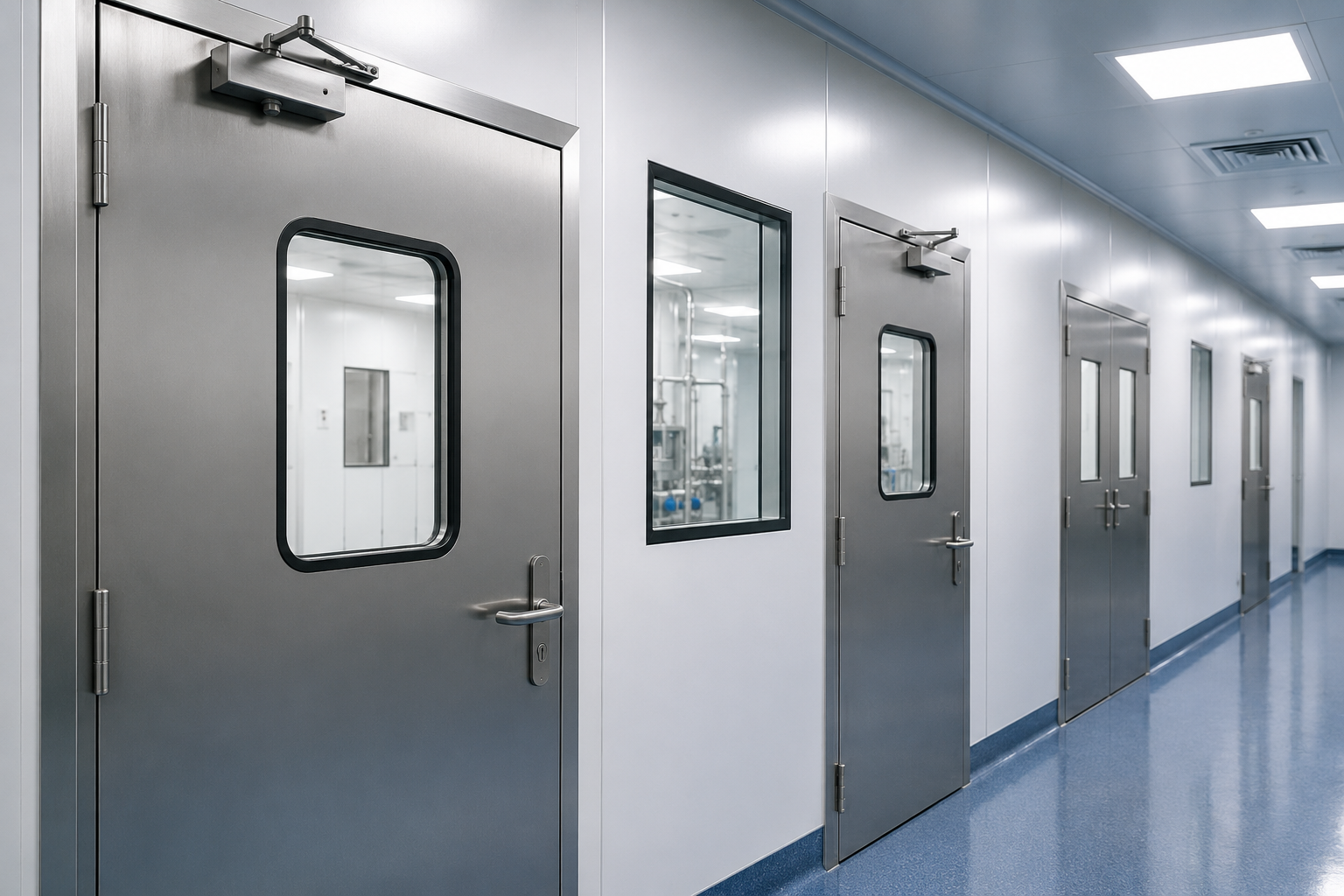
Introduction
Walk into any pharmaceutical plant, a NABH-accredited hospital, or a semiconductor fab, and you'll notice something the architects didn't leave to chance: almost every internal door is metal. Not wood, not aluminium, not fibreglass — metal.
That's not an aesthetic decision. A door in a controlled environment is a functional barrier that has to manage airflow, block fire, resist chemical exposure, survive hundreds of open-close cycles a day, and stay easy to clean without harbouring bacteria in a cracked seam. Very few materials satisfy all of those requirements simultaneously. Industrial metal doors do, which is why they've become the default specification across pharmaceutical, healthcare, food processing, electronics, and heavy industrial facilities.
This guide covers what industrial metal doors are, how they're built, where each type fits, how they compare to wood, aluminium, and FRP alternatives, and what to check before you sign a purchase order.
Why Industrial Facilities Need High-Performance Doors
A standard commercial door is designed around one job: separating two rooms. An industrial or cleanroom door has to do several jobs at once:
- Contain fire for a certified duration so occupants can evacuate and damage stays localized
- Maintain pressure differentials between cleanroom zones so contaminants don't migrate against the airflow design
- Resist corrosion and chemical exposure in wash-down areas, labs, and processing units
- Withstand heavy-duty cycling — some production doors open and close hundreds of times per shift
- Support hygienic design with no exposed joints, absorbent surfaces, or places for microbes to collect
Meet regulatory audits from bodies like FDA, WHO, and NABH without requiring rework
Doors made from softer or more porous materials tend to fail on at least one of these fronts, usually the fire rating or the hygienic surface requirement — which is the core reason metal has become the industry default.
What Are Industrial Metal Doors?
Industrial metal doors are engineered door assemblies — leaf, frame, and hardware — built primarily from galvanized iron (GI) or stainless steel (SS) sheets. Most designs sandwich an insulating or reinforcing core between two metal skins rather than using a single solid slab, which keeps the door lightweight while still delivering structural rigidity and, where required, fire resistance.
- Common core materials include:
- Honeycomb (kraft or aluminium) — lightweight, adds rigidity, standard for non-fire-rated and general industrial doors
- Rockwool / mineral wool / ceramic wool — used in fire-rated doors, since these materials resist combustion better than foam cores
- Steel reinforcement — added at hinge and lock points for structural integrity regardless of core type
- The outer skins are typically powder-coated or polished for corrosion resistance, and the vertical edges are mechanically interlocked (rather than just welded) to add strength and keep the leaf flat under repeated use — a detail worth checking during inspection, since it affects long-term door alignment.
Types of Industrial Metal Doors
- GI (Galvanized Iron) Doors — Zinc-coated steel doors, usually powder coated, offering a strong corrosion-resistance-to-cost ratio. A common choice for general industrial areas, warehouses, and cleanrooms with moderate hygiene requirements.
- Stainless Steel Doors (SS 304 / SS 316) — Higher corrosion and chemical resistance than GI, with a polished or brushed finish. SS 316 in particular is preferred where chemical or saline exposure is higher (labs, certain pharma processes). Typically built with a solid or honeycomb core and precision-welded construction.
- Fire Rated / Fire Resistant Doors — Two metal skins (GI or SS) sandwiching honeycomb, rockwool, or ceramic wool insulation, with steel reinforcement for structural stability. Tested for a specific duration of fire containment — commonly available in ratings such as 120 minutes.
- Clean Room / GMP Doors — Purpose-built for controlled environments, with mechanically interlocked edges, flush interfacing profiles for wall integration, and options like double-glazed vision panels, door closers, and digital access hardware.
- Emergency Exit Doors — Single-leaf metal doors fitted with panic bar hardware and configured for outward opening, often carrying the same fire ratings as standard fire doors.
Metal Doors Used in Cleanrooms
Cleanroom doors serve a purpose beyond separating rooms — they're part of the contamination-control system. A well-specified cleanroom metal door will typically include:
- Flush, gasket-sealed edges to support pressure differential control between zones
- Double-glazed vision panels for visual monitoring without opening the door
- Interfacing profiles that mount flush to modular wall or partition panel systems
- Powder-coated or polished finishes in a range of colors for zone identification
- Door closers to maintain consistent seal and pressure control
- Options for automatic or manual sliding configurations where swing clearance is limited
These doors are used for pharmaceutical manufacturing suites, hospital operation theatres and modular OT complexes, biotechnology labs, and electronics cleanrooms — anywhere air quality classification (per ISO 14644) has to be maintained room to room.
Applications Across Different Industries
| Industry | Typical Door Requirement |
| Pharmaceutical manufacturing | fire-rated, flush-seal cleanroom doors |
| Hospitals & healthcare | NABH-compliant OT doors, hygienic GI/SS doors, fire exit doors |
| Semiconductor & electronics | Static-control-friendly cleanroom doors, tight tolerance seals |
| Food processing | Corrosion-resistant SS/GI doors, wash-down compatible |
| Chemical industries | SS 316 doors for chemical and corrosion resistance |
| Research laboratories | SS doors with vision panels |
| Warehouses & EPC projects | Hollow metal doors, fire-rated commercial doors |
Advantages of Metal Doors
- Fire performance — tested and rated assemblies rather than a material that simply "resists" fire
- Hygienic surface — non-porous, easy to wipe down, no grain or seams for microbial growth
- Corrosion resistance — galvanized or stainless finishes hold up to humidity and washdown
- Structural durability — steel reinforcement and mechanical interlocking withstand high-cycle daily use
- Lower total cost of ownership — less frequent replacement than wood or FRP in demanding environments
- Design flexibility — compatible with vision panels, automation, access control, and panic hardware
- Regulatory alignment — easier to document and audit against GMP, NABH, and fire code requirements
Metal Doors vs Wooden Doors
| Factor | Metal Doors | Wooden Doors |
| Fire resistance | Certified ratings available (e.g., 120 min) | Limited, degrades with age |
| Moisture resistance | Excellent (GI/SS) | Poor — warps, swells, rots |
| Hygiene | Non-porous, easy to sanitize | Absorbs moisture and microbes |
| Lifespan in industrial use | Long, low maintenance | Shorter, needs refinishing |
| Cleanroom suitability | High | Generally unsuitable |
| Upfront cost | Higher | Lower |
Metal Doors vs Aluminium Doors
| Factor | Metal (Steel/SS) Doors | Aluminium Doors |
| Structural strength | Higher, better for heavy-duty use | Lighter, less impact-resistant |
| Fire rating | Achievable with insulated cores | Aluminium has a low melting point, limiting fire rating options |
| Corrosion resistance | Very high (GI/SS) | Good, but can pit/corrode with certain chemicals |
| Cost | Moderate to high | Moderate |
| Best fit | Fire-rated, heavy-traffic, cleanroom | Lightweight partitions, non-fire-rated openings |
Metal Doors vs FRP Doors
| Factor | Metal Doors | FRP (Fibre-Reinforced Plastic) Doors |
| Fire performance | Well-established rated assemblies | Fire performance varies by resin/formulation |
| Chemical resistance | Very good (SS 316 especially) | Very good |
| Structural rigidity | High, supports heavier hardware | Moderate |
| Repairability | Can be reworked/re-coated | Harder to repair once damaged |
| Typical use case | Fire-rated openings, high-traffic doors | Chemical storage, wet processing rooms |
Factors to Consider Before Buying
- Application environment — cleanroom, wet processing, cold storage, or general industrial
- Required fire rating — check against local fire code and facility risk assessment
- Material grade — GI for cost efficiency, SS 304/316 for higher hygiene or chemical exposure
- Core type — honeycomb for standard use, rockwool/ceramic wool for fire rating
- Door configuration — single or double leaf, swing or sliding, based on space and traffic
- Hardware needs — vision panels, door closers, mortise locks, panic bars, digital access
- Frame material and installation profile — must match existing wall or partition system
- Finish — powder coating color-matched to zone identification schemes
- Supplier documentation — test certificates for fire rating and material grade
Compliance with ISO, GMP, NABH, FDA, WHO, and Fire Safety Standards
Cleanroom and pharmaceutical facilities are typically designed to ISO 14644 cleanroom classification standards, with door systems selected to support the pressure and sealing requirements of that classification rather than being separately "ISO certified" as standalone products. GMP guidelines (as referenced by regulators such as the FDA and WHO) call for surfaces — including doors — that are smooth, cleanable, and resistant to microbial buildup, which is why non-porous metal finishes are favored over wood or absorbent materials.
In healthcare facilities, NABH accreditation standards for infrastructure expect hygienic, durable finishes in clinical and OT areas, again pointing toward metal door systems.
For fire performance, doors are tested against recognized fire-test standards — in India, commonly IS 3614 (Part II) for fire-check door assemblies, alongside international references such as BS 476 (Part 22). Always ask your supplier for the specific test certificate and rating duration (e.g., 120 minutes) rather than relying on a general "fire resistant" label, since ratings vary by construction and core material.
Maintenance Requirements
- Inspect door seals and gaskets quarterly for wear that could affect pressure control
- Check hinge alignment and closer tension to prevent sagging or slow closing
- Wipe down surfaces with non-abrasive, GMP-approved cleaning agents
- Re-torque hardware (locks, panic bars, vision panel frames) periodically
- Inspect powder-coated or painted finishes for chips that expose bare metal to corrosion
- Verify fire door labels/certificates remain legible and undamaged during audits
Common Mistakes Buyers Make
- Choosing based on price alone without checking fire-rating test documentation
- Specifying GI where chemical exposure actually calls for SS 316
- Ignoring frame compatibility with existing modular wall/partition systems
- Skipping a site survey, leading to sizing or swing-clearance issues at installation
- Overlooking long-term maintenance costs when comparing metal to lower-upfront-cost alternatives
- Not confirming hardware (locks, closers, panic bars) is rated to match the door's fire rating
Cost Factors
Pricing for industrial metal doors depends on:
- Material grade — GI is generally more economical than SS 304/316
- Core type — honeycomb costs less than rockwool/ceramic wool cores
- Fire rating — higher-rated assemblies cost more due to certified materials and testing
- Size and configuration — double-leaf and larger openings scale up cost
- Hardware — vision panels, automatic operators, and access control add to the base price
Finish — powder coating and custom colors vs. standard finishes
Buyers should request itemized quotes that separate the door leaf, frame, and hardware so costs can be compared apples-to-apples across suppliers.
Installation Best Practices
- Confirm rough opening dimensions against the door and frame size before installation
- Verify wall/partition interfacing profile compatibility for a flush fit
- Install frames plumb and square — misalignment is the leading cause of early hardware wear
- Test door closers and seals for correct pressure and closing speed after installation
- For fire-rated doors, confirm the frame and hardware combination is part of the same tested assembly
- Document installation with photos and commissioning checklists for regulatory audit trails
Future Trends in Industrial Door Technology
- Touchless and digital access integration for hygienic, contactless operation in cleanrooms and hospitals
- Smart monitoring sensors for real-time seal integrity and pressure-differential tracking
- Antimicrobial powder coatings for additional surface protection in healthcare settings
- Modular, pre-engineered assemblies that reduce on-site fabrication and speed up EPC project timelines
- Sustainability-focused finishes and recyclable core materials as facilities pursue green building certifications
Expert Buying Checklist
- Confirmed application (cleanroom, wet area, cold storage, general industrial)
- Verified required fire rating and requested test certificate
- Selected material grade (GI, SS 304, or SS 316) matched to exposure conditions
- Chosen core type (honeycomb, rockwool/ceramic wool) for the use case
- Confirmed door configuration (single/double leaf, swing/sliding)
- Specified hardware (vision panel, closer, mortise lock, panic bar, digital access)
- Checked frame and wall-interfacing compatibility
- Requested itemized quote (leaf, frame, hardware separated)
- Reviewed supplier's compliance documentation (fire test standard referenced)
- Planned installation and commissioning documentation for audit records
Conclusion
Industrial metal doors earn their place in cleanrooms, pharmaceutical plants, hospitals, and heavy industrial facilities because they solve several problems at once — fire containment, hygiene, corrosion resistance, and structural durability — in a single engineered assembly. The right choice isn't simply "metal over wood"; it's matching material grade, core type, and fire rating to the specific demands of your facility, and verifying that choice against real test documentation rather than marketing claims. A door that's correctly specified up front will outlast several cycles of a poorly matched alternative and save significant rework and compliance risk down the line.
Comparison Tables (Standalone Set)
Steel vs Stainless Steel Doors
| Factor | Steel (GI) Doors | Stainless Steel Doors |
| Corrosion resistance | Good (galvanized + powder coat) | Excellent, especially SS 316 |
| Cost | Lower | Higher |
| Hygiene level | Good | Very high |
| Best fit | General industrial, standard cleanrooms | Pharma, food, chemical, high-hygiene areas |
GI vs SS Doors
| Factor | GI Doors | SS Doors |
| Material | Galvanized steel, powder coated | SS 304 or SS 316, polished/brushed |
| Chemical resistance | Moderate | High (especially SS 316) |
| Typical cost | Lower | Higher |
| Common use | General cleanrooms, warehouses | Pharma, labs, food processing |
Metal vs Wooden Doors
| Factor | Metal Doors | Wooden Doors |
| Fire rating | Certified assemblies available | Limited |
| Moisture resistance | High | Low |
| Cleanroom suitability | Yes | Not recommended |
| Maintenance | Low | Higher (refinishing needed) |
Sliding vs Hinged Doors
| Factor | Sliding Doors | Hinged Doors |
| Space requirement | Low (no swing clearance) | Needs swing clearance |
| Seal quality | Can be excellent with proper tracks | Generally easier to seal tightly |
| Common use | Tight cleanroom corridors | Standard rooms, fire exits |
| Automation compatibility | High | Moderate |
Fire Rated vs Standard Doors
| Factor | Fire Rated Doors | Standard Doors |
| Core material | Rockwool, ceramic wool, or fire-rated honeycomb | Standard honeycomb |
| Certification | Tested to standards (e.g., IS 3614 Part II, BS 476 Part 22) | Not fire-tested |
| Cost | Higher | Lower |
| Required in | Fire exits, compartmentalized zones per fire code | Non-critical internal partitions |
Selection Checklist
- Identify the room's function (cleanroom class, wet area, cold zone, general industrial)
- Determine required fire rating based on facility fire safety plan
- Match material grade to exposure (GI vs SS 304 vs SS 316)
- Select core type for insulation/fire needs
- Decide swing vs sliding based on space and workflow
- Choose hardware package (vision panel, closer, lock type, panic hardware)
Inspection Checklist
- Visual check for surface damage, dents, or coating chips
- Confirm mechanically interlocked edges are flush and true
- Verify seals/gaskets are intact and compressing correctly
- Check hinge and closer alignment
- Confirm fire rating label/certificate is present and legible
- Test lock, panic bar, and vision panel operation
Maintenance Checklist
- Quarterly seal and gasket inspection
- Periodic hinge and closer adjustment
- Routine cleaning with GMP-approved, non-abrasive agents
- Annual review of fire door certification status
- Touch-up of powder coating where chipped
- Hardware torque check (locks, panic bars, closers)
Installation Checklist
- Confirm rough opening dimensions match door/frame specs
- Verify wall interfacing profile compatibility
- Install frame plumb and square
- Test door swing/slide operation and seal pressure
- Confirm fire-rated assembly components are all from the tested set
- Document installation with commissioning photos/records
Buying Checklist
- Request itemized quote (leaf, frame, hardware)
- Ask for fire test certificate and rating duration
- Confirm material grade and core type in writing
- Verify lead time and installation support
- Check warranty terms
- Confirm after-sales maintenance support availability
Key Takeaways
- Industrial metal doors combine fire performance, hygiene, and structural durability in one assembly — a combination wood, aluminium, and FRP each struggle to match simultaneously.
- Material grade should match exposure: GI for general use, SS 304/316 for high-hygiene or chemical environments.
- Core material (honeycomb, rockwool/ceramic wool) determines whether a door is optimized for insulation, weight, or fire rating.
- Always verify fire ratings against actual test certificates (e.g., IS 3614 Part II, BS 476 Part 22) rather than general marketing claims.
- Installation quality and frame compatibility affect long-term performance as much as the door material itself.
FAQs
1. Why are metal doors preferred in cleanrooms?
Cleanrooms require surfaces that don't shed particles, absorb moisture, or harbor microbial growth — conditions metal doors satisfy far better than wood or untreated composites. Galvanized or stainless steel skins are non-porous and easy to wipe down with GMP-approved cleaning agents, which matters for regulatory audits. Metal doors also support the mechanically interlocked, flush-seal construction cleanrooms need to maintain pressure differentials between zones. Combined with fire-rated core options, this makes metal the practical default rather than a purely aesthetic choice for pharmaceutical, hospital, and electronics cleanrooms.
2. Which metal door is best for pharmaceutical facilities?
Most pharmaceutical facilities specify GI or SS 304 doors for general cleanroom areas, moving to SS 316 where chemical exposure is higher, such as certain processing or lab areas. The door should have a flush-seal, mechanically interlocked construction, a or honeycomb core depending on insulation needs, and fire-rated variants where required by the facility's fire safety plan. The right choice depends on the specific room's classification and exposure profile, so it's worth confirming material grade against your facility's GMP documentation before finalizing a specification.
3. Are stainless steel doors better than GI doors?
Stainless steel doors offer higher corrosion and chemical resistance than GI doors, particularly SS 316 grade, making them a better fit for chemical processing, food industries, and high-hygiene pharmaceutical areas. GI doors, however, are more cost-effective and perform well in general industrial and standard cleanroom settings where chemical exposure is lower. Neither is universally "better" — the right choice depends on matching the door's material grade to the specific exposure and hygiene requirements of the room it's protecting.
4. What standards should industrial doors comply with?
Industrial and cleanroom doors are typically selected to support facility-level compliance with ISO 14644 cleanroom classification, GMP guidelines referenced by regulators like the FDA and WHO, and healthcare infrastructure standards such as NABH accreditation criteria. For fire performance specifically, doors should be tested against recognized standards such as IS 3614 (Part II) in India or BS 476 (Part 22) internationally. Always request the specific test certificate and rated duration from your supplier rather than accepting a general "fire resistant" claim.
5. How long do industrial metal doors last?
With proper installation and regular maintenance, industrial metal doors typically outlast wood, aluminium, or FRP alternatives in demanding environments, since steel and stainless steel resist the moisture absorption, warping, and corrosion that shorten the lifespan of other materials. Lifespan depends heavily on maintenance discipline — seal and gasket inspection, hinge alignment checks, and prompt touch-up of any coating damage all extend service life. Facilities that skip routine maintenance will see reduced lifespan regardless of the door material chosen.
6. What industries require metal doors?
Pharmaceutical manufacturing, biotechnology, hospitals and healthcare facilities, semiconductor and electronics manufacturing, food processing, chemical industries, and research laboratories all commonly specify metal doors. Each industry has slightly different priorities — pharmaceutical and healthcare facilities prioritize hygiene and GMP/NABH alignment, chemical and food industries prioritize corrosion resistance, and semiconductor cleanrooms prioritize tight sealing and contamination control. Across all of these, metal's combination of durability, cleanability, and fire performance makes it the practical standard.
7. What is the difference between fire-rated and standard metal doors?
Fire-rated metal doors use a core material — typically rockwool, ceramic wool, or fire-rated honeycomb — specifically selected and tested for fire containment, and the complete assembly (door, frame, and hardware) is certified to a tested standard such as IS 3614 Part II or BS 476 Part 22 for a rated duration. Standard metal doors may use similar steel skins but are built with general-purpose honeycomb cores that haven't been fire-tested. Fire-rated doors are required wherever local fire codes mandate compartmentalization, such as fire exits and zone separations within a facility.
8. How do metal doors improve cleanroom performance?
Metal doors support cleanroom performance through flush, mechanically interlocked construction that helps maintain the pressure differentials cleanrooms rely on to control airflow direction and contamination. Their non-porous surfaces don't shed particles or absorb moisture, reducing the risk of microbial growth that could compromise air quality classifications. Features like gasket seals, vision panels for monitoring without opening the door, and door closers for consistent sealing all contribute to keeping the room's designed air quality class intact.
9. Should I choose a sliding or hinged industrial metal door?
Sliding doors work well in tight cleanroom corridors where swing clearance isn't available and are easier to automate for touchless operation. Hinged doors are generally simpler to seal tightly and remain the standard choice for fire exits and most standard-configuration rooms. The decision comes down to available space, traffic patterns, and whether the opening needs to be part of a fire-rated egress path, since fire exit requirements typically favor hinged, panic-bar-equipped configurations.