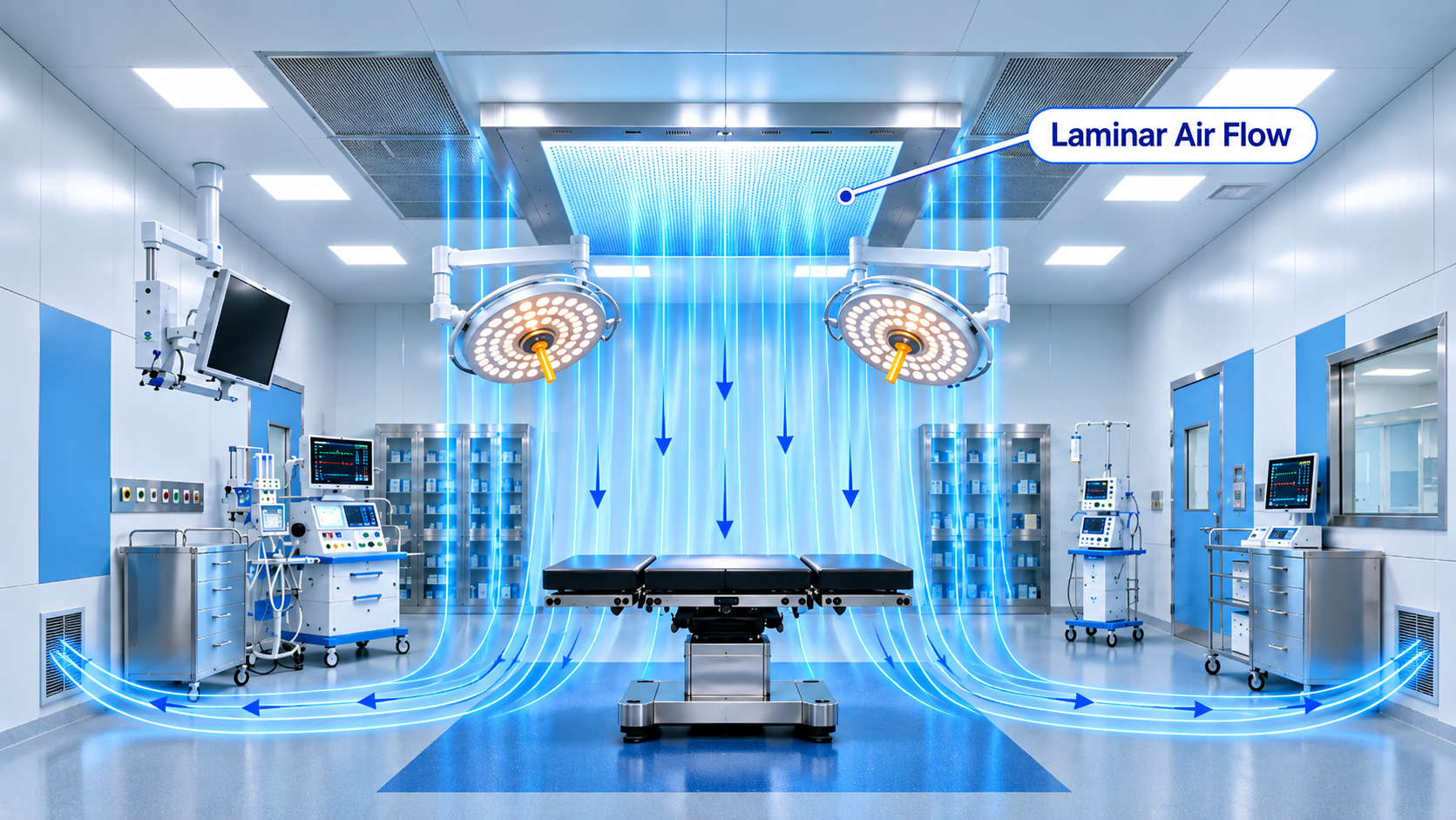
Laminar airflow in a modular OT is a controlled stream of HEPA-filtered air that moves downward in a smooth, uniform pattern over the operating table. It pushes airborne particles and microbes away from the surgical site and out of the room, which lowers the risk of surgical site infections.
If you are planning a new operation theatre or upgrading an existing one, understanding this system helps you make better decisions on design, budget and compliance. Here are the five things every hospital administrator, architect and biomedical engineer should know.
1. What “Laminar” Actually Means
In a normal room, air mixes and swirls. This is called turbulent or mixed flow, and it spreads particles in every direction.
In laminar (unidirectional) flow, air travels in parallel layers at a steady speed with very little mixing. In an OT, a ceiling-mounted laminar air flow (LAF) unit sits above the operating table and delivers a “curtain” of clean air straight down. The air then sweeps across the patient and surgical team and leaves through low-level return grilles.
The result is a clean zone around the patient, where particles from staff, instruments and the room are carried away instead of settling on the wound.
2. HEPA Filters Are the Heart of the System
Laminar airflow is only as clean as the air that enters it. That is why a modular OT uses HEPA (High-Efficiency Particulate Air) filters at the terminal point, in the ceiling directly above the surgical zone.
- H13 and H14 HEPA filters capture the vast majority of particles at the most penetrating particle size, including bacteria-carrying particles.
- Air passes through pre-filters and fine filters in the air handling unit first, so the HEPA filter lasts longer and performs consistently.
- The filter must be sealed properly. A leak around the frame defeats the purpose of the filter.
Because HEPA filtration depends on the whole air path, the OT should be supported by a properly engineered HVAC and air handling system designed for controlled environments.
3. Pressure, Air Changes and Airflow Pattern Work Together
Laminar flow does not work alone. Three related factors keep the OT clean:
- Positive pressure: The OT is kept at a higher pressure than the corridor and adjoining rooms, so air flows out of the OT rather than into it. Typical design practice maintains a pressure differential of around 10–15 Pa, though your project standard or guideline decides the exact value.
- Air changes per hour (ACH): A high number of air changes dilutes and removes contaminants. Commonly referenced guidelines such as ASHRAE 170 call for at least 20 total air changes per hour in operating rooms.
- Airflow velocity: Air leaving the laminar unit is typically designed in the range of roughly 0.2–0.3 m/s. This is fast enough to hold the clean zone and slow enough to avoid discomfort or disturbing the surgical field.
Temperature and humidity matter too. Most ORs are held at around 20–24°C and 30–60% relative humidity for patient safety and staff comfort.
4. The Modular OT Design Makes Laminar Flow Perform Better
A laminar system can be undermined by the room around it. This is where a modular OT has real advantages over conventional brick-and-plaster construction:
- Smooth, low-joint wall and ceiling panels do not shed particles and are easy to clean and disinfect.
- Airtight construction helps the room hold its pressure, so the HVAC does not have to fight leaks.
- Hermetically sealed doors protect the pressure cascade and prevent contaminated air from entering.
- Integrated layouts place the laminar unit, supply diffusers, return grilles and equipment where the airflow actually needs them.
- Faster installation means less disruption to your hospital operations.
When panels, doors, ceiling and HVAC are planned together, the airflow pattern is protected from the start.
5. Validation Proves It Works
A laminar airflow system that looks perfect on drawings is not enough. It has to be tested and documented. A proper cleanroom and OT validation normally includes:
- HEPA filter integrity test (leak testing)
- Airborne particle count to confirm the cleanliness class
- Air velocity and uniformity across the laminar zone
- Pressure differential between the OT and adjacent areas
- Air changes per hour, temperature and humidity
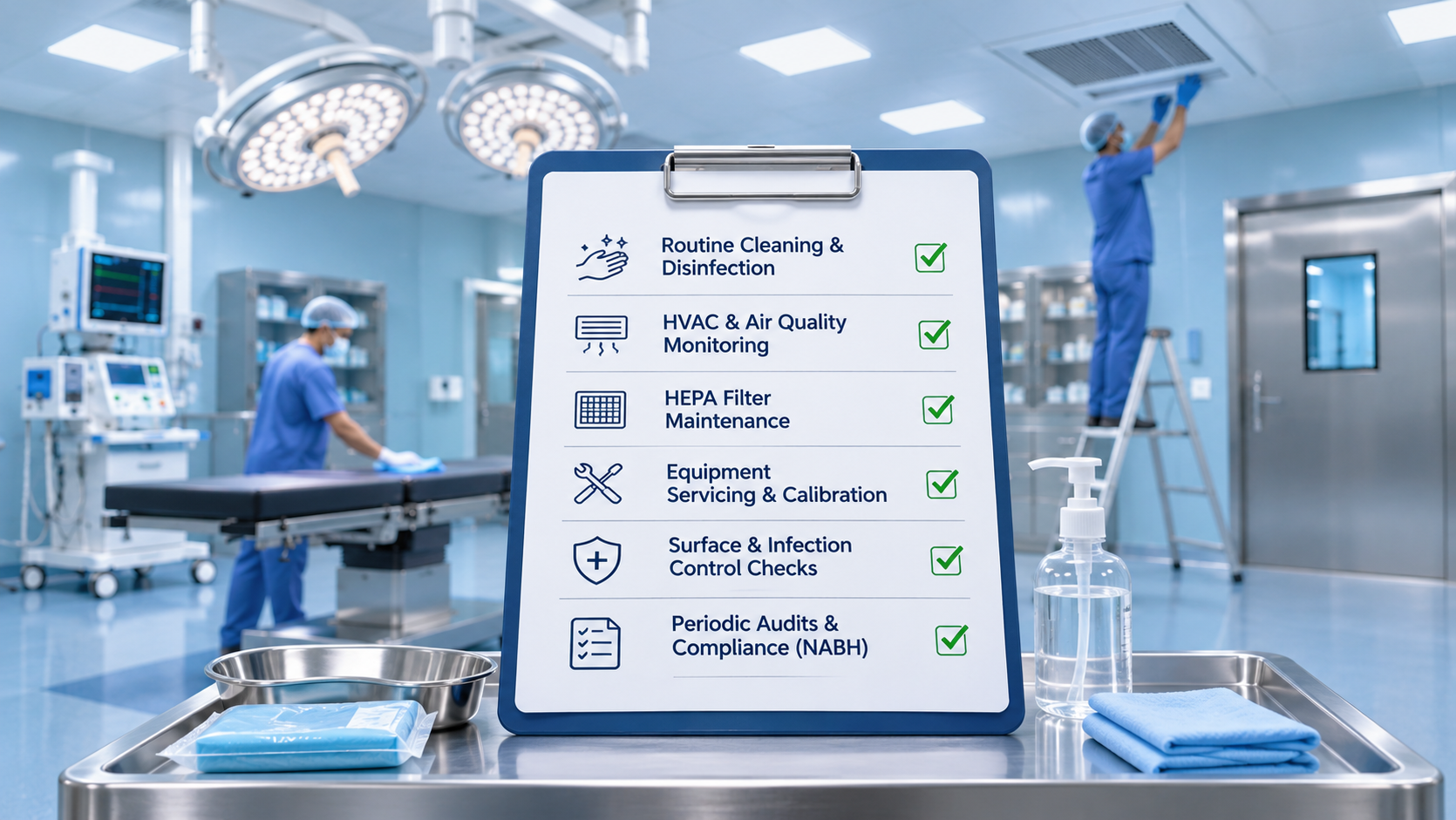
Validation should be done after installation and repeated at regular intervals, as defined by your hospital’s quality protocol, and after any major maintenance or filter replacement. The reports also give you audit-ready documentation.
Quick Summary
| Factor | What it does |
|---|---|
| Laminar airflow | Pushes particles away from the surgical site |
| HEPA filtration | Removes airborne particles and microbes from supply air |
| Positive pressure | Stops contaminated air from entering the OT |
| Air changes per hour | Dilutes and removes contaminants |
| Modular construction | Keeps surfaces clean and the room airtight |
| Validation | Proves performance with documented tests |
Frequently Asked Questions
What is laminar airflow in an operation theatre?
It is a unidirectional stream of HEPA-filtered air delivered from the ceiling over the operating table. It creates a clean zone around the patient and carries particles away from the surgical site.
Is laminar airflow required in every OT?
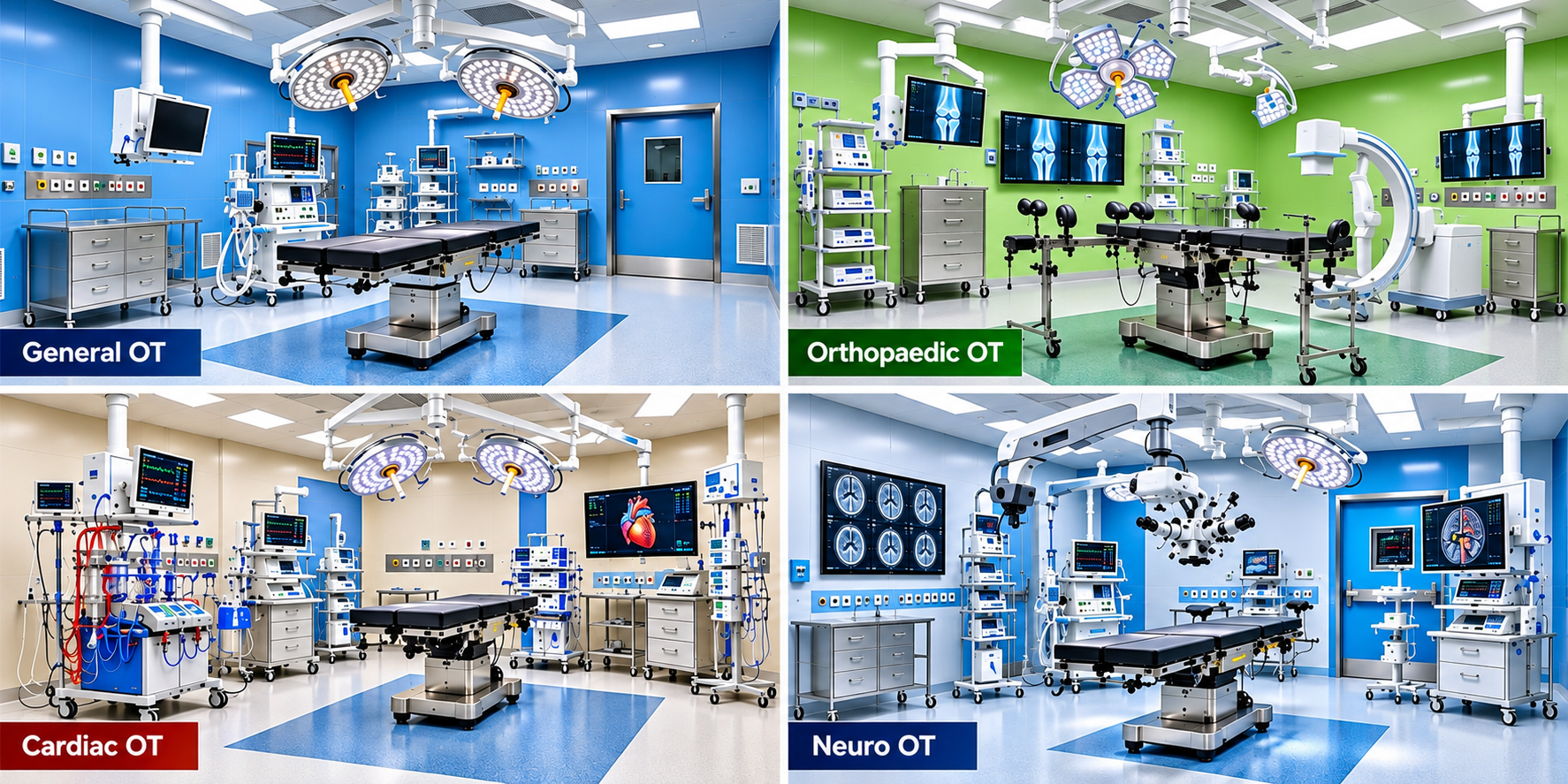
Not always. Requirements depend on the type of surgery, hospital guidelines and applicable standards. Laminar flow is most commonly used in high-risk procedures such as joint replacement, cardiac and neurosurgery, and transplants. Your project guidelines and clinical team should decide this.
How often should laminar airflow in an OT be validated?
Validation is done at installation and then periodically as per your quality protocol or applicable guidelines, and after any major repair or filter change.
Can laminar airflow be installed in a modular OT?
Yes. Modular OTs are well suited to laminar flow, because the ceiling, panels, doors and HVAC can be designed and installed as one integrated system.
What is the difference between laminar and turbulent airflow?
Laminar flow moves in smooth parallel layers in one direction. Turbulent (mixed) flow swirls in all directions and spreads contaminants more easily.
Planning a Modular OT or Upgrading Your Airflow System?
Venair Solutions is a Bangalore-based company that designs, installs and validates modular OTs, HVAC systems, cleanroom doors and controlled environments across India. Share your room size, layout and requirements, and our team will help you plan the right setup.
Request a Free Cleanroom Consultation | Call: 7760195229 | Email: marketing@venairsolutions.com | WhatsApp: 9845190711
No. 15, Sri Sumukha Nivas, APC Circle, Jigani Industrial Area, Anekal (Taluk), Bangalore - 560105