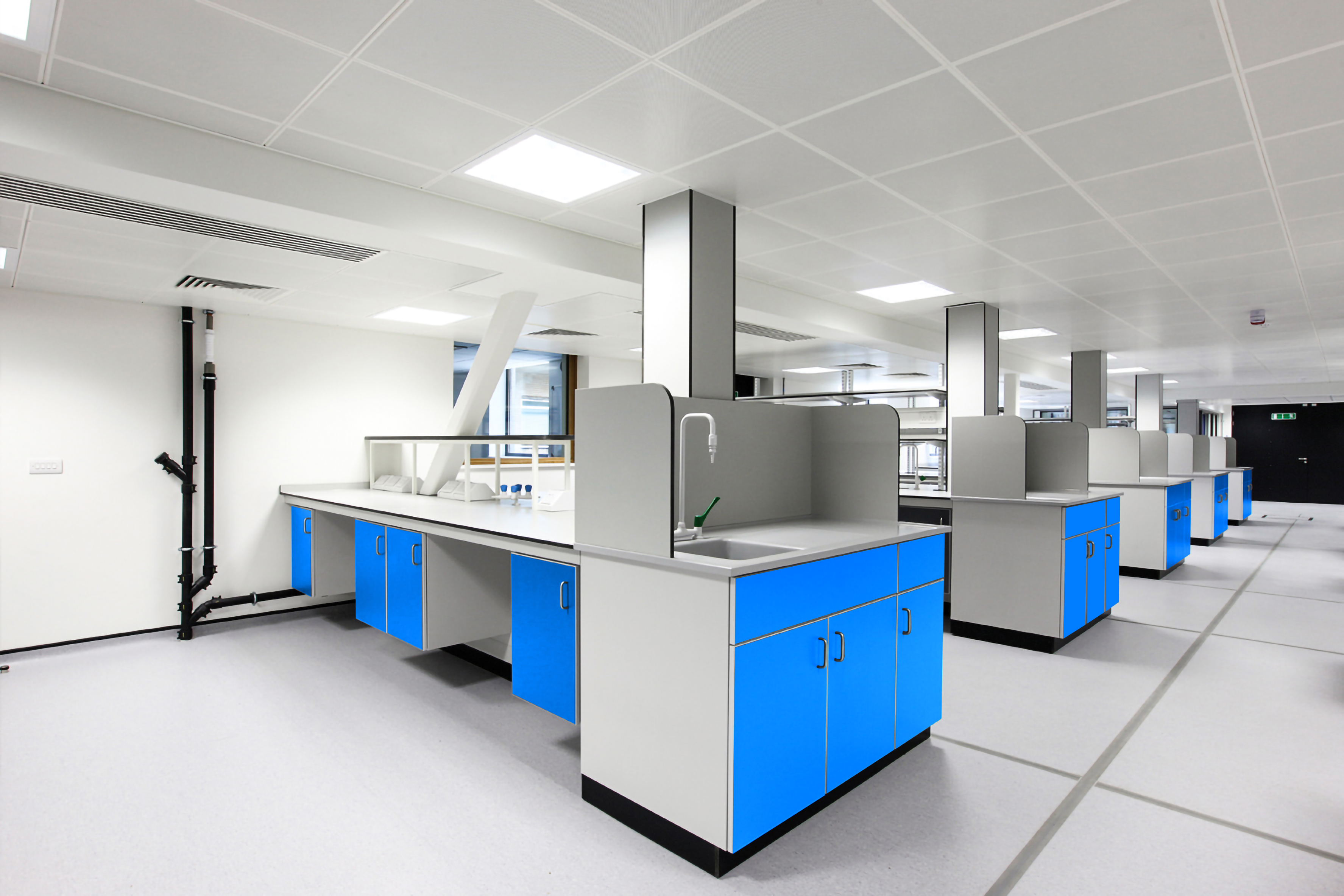
Lab furniture is specified once and used for 15 to 20 years. A bench that sags under a floor-standing centrifuge, a worktop that stains under routine reagents, or a service line that was never planned for can only be fixed by tearing out installed work. This guide covers the three decisions that most often go wrong in lab furniture specification: worktop loads, chemical resistance, and service provisions. It is written for lab planners, facility heads, procurement teams and architects working on pharmaceutical, biotech, healthcare, research and electronics labs in 2026.
Quick answer: A correct lab furniture specification states (1) the uniformly distributed and point loads each bench must carry, (2) the exact chemicals, concentrations and cleaning agents the worktop will see, and (3) every gas, water, vacuum, drain, power and data point, with its location, before the layout is frozen.
1. Worktop Loads: Specify What the Bench Must Carry
Know the two types of load
- Uniformly distributed load (UDL): the weight spread across the worktop, such as glassware, reagent bottles, small instruments and sample racks. It is usually quoted in kg per square metre or kg per linear metre.
- Point (concentrated) load: the weight of a single heavy item resting on a small footprint, such as a floor-top autoclave, a centrifuge, a water bath, a muffle furnace or a microscope on an anti-vibration table.
A bench can pass a UDL requirement and still fail under a point load. Both numbers belong in the specification.
Build a load schedule before you request quotes
List every item that will sit on or under each bench run, with its weight and footprint. Group benches by duty:
| Bench duty | Typical contents | What to specify |
|---|---|---|
| Light duty | Sample prep, documentation, small instruments | UDL rating, standard frame |
| General lab duty | Glassware, reagents, hot plates, small analysers | UDL rating, reinforced frame at cantilevers |
| Heavy duty | Centrifuges, autoclaves, furnaces, large analysers | Point-load rating, reinforced frame, floor-supported legs |
| Precision | Analytical balances, microscopes | Vibration isolation, stable and level worktop |
Check the parts that fail first
- Frame and leg design: welded or bolted frames with adjustable levelling feet carry load better than light-gauge assemblies.
- Worktop thickness and support spacing: a thin worktop on wide spans deflects over time. Ask for the maximum unsupported span.
- Cantilever and wall-mounted elements: shelves, reagent racks and overhead units have separate load limits from the main bench.
- Deflection limit: ask how much the worktop may flex under rated load, not just whether it breaks.
- Floor loading: a heavy bench with equipment on it adds to the slab’s live load. Confirm the structural capacity with the project’s civil consultant, especially on upper floors.
Specification tip: ask the supplier for a written load rating per bench type, backed by test results from an applicable standard such as EN 13150 or the SEFA 8 recommended practices. A catalogue claim with no test basis is not a specification.
2. Chemical Resistance: Match the Surface to the Chemicals
No single worktop material resists every chemical. The correct approach is to list what actually touches the surface and choose the material against that list.
Build a chemical exposure list
Record, for each lab zone:
- Acids and bases, with concentrations.
- Organic solvents (alcohols, acetone, ethyl acetate, chlorinated solvents).
- Oxidisers and strong disinfectants.
- Stains and dyes.
- Cleaning agents and sanitisers used daily. These are often harsher on surfaces than the reagents.
- Heat sources (hot plates, autoclave loads, hot glassware).
Worktop material comparison
| Material | Strengths | Limits | Typical use |
|---|---|---|---|
| Stainless steel (SS 304) | Hygienic, seamless fabrication, easy to clean, heat tolerant | Attacked by chlorides and some acids over time | Cleanrooms, pharma, microbiology, sample prep |
| Stainless steel (SS 316) | Better resistance to chlorides and many acids than 304 | Higher cost | Labs with saline, chloride or harsher cleaning regimes |
| Epoxy resin | Wide resistance to acids, alkalis and solvents, good heat tolerance, solid through the thickness | Can be damaged by strong oxidising acids, heavy | Chemistry, analytical and QC labs |
| Phenolic resin | Good moisture and chemical resistance, durable | Limited against some strong oxidisers | General research and teaching labs |
| Polypropylene | Strong against acids and alkalis, no corrosion | Softens with heat, limited against some solvents and oxidisers | Acid handling, wash areas, fume cupboard bases |
| High-pressure laminate (HPL) | Economical, clean appearance | Weak against moisture at edges and strong chemicals | Dry areas, documentation benches |
Test data matters more than a material name
Within a material family, performance depends on the product. Ask for:
- Chemical spot-test results against a defined reagent set (the SEFA 3 style of testing is widely used for worktops), including exposure time and the rating scale.
- Heat resistance data for hot-plate and hot-glassware contact.
- Edge and joint details. Most chemical damage starts at a joint, a cut-out or an unsealed edge, not on the open surface.
Look beyond the worktop
- Sinks and drains: specify materials rated for the effluent. Acid waste lines need chemically resistant piping, not standard plumbing.
- Cabinet carcasses and shelves: chemical storage units need resistant interiors, and flammable storage needs units built for that purpose.
- Fittings and hardware: handles, hinges and taps corrode in the same atmosphere that damages worktops. Specify corrosion-resistant fittings.
- Cleanability: in pharma and cleanroom-adjacent labs, smooth, coved, low-joint surfaces with no ledges reduce places where contamination collects.
3. Service Provisions: Plan Utilities Before the Layout
Services are the most commonly under-specified part of a lab. Retrofitting a gas line or an extra power point into a finished bench run costs far more than planning it at the start.
Service checklist
| Service | What to define |
|---|---|
| Water (potable and purified) | Point locations, pressure, taps, isolation valves, purified water outlets |
| Drainage | Sink positions, waste material, fall to drain, trap and chemical-resistant piping |
| Gas (natural gas, LPG, nitrogen, compressed air, others) | Outlet type per bench, pipeline versus cylinder, isolation valves, leak safety |
| Vacuum | Number of outlets, pump location, line material |
| Electrical | Socket count per bench, circuit capacity, RCCB protection, earthing, dedicated circuits for heavy equipment |
| Data and communication | Ethernet points, instrument connectivity, networking provisions |
| Lighting and task lighting | Bench-level illumination, shadow-free areas for fine work |
| Safety | Eyewash, safety shower, emergency isolation, fire safety placement |
How services reach the bench
- Wall-bench service panels: utilities run in the wall and terminate at bench height. This suits perimeter benches.
- Service pillars and ceiling pendants: these deliver services to island benches without floor trenches.
- Reagent shelves with integrated services: these combine storage with electrical and gas points on one bench-top unit.
- Under-bench service voids: these keep pipes and cables accessible for maintenance and inside the furniture envelope.
Layout rules that prevent problems later
- Aisle width: leave enough clear width between benches for two people to pass and for equipment trolleys. A common planning range is 1.2 to 1.5 metres, adjusted to the lab’s traffic and code requirements.
- Bench depth and height: standard working benches are commonly built around 750 mm depth for wall benches and wider for island benches, with working heights chosen for standing or seated use.
- Sink location: place sinks near exits and away from sensitive equipment.
- Fume cupboards and airflow: fume cupboards, ducted enclosures and bench positions all affect room airflow. Coordinate bench placement with the HVAC design so that air patterns are not disrupted. Venair’s HVAC systems are planned alongside lab layouts for this reason.
- Future flexibility: modular furniture lets benches be reconfigured or extended as the lab’s work changes, without replacing the whole installation.
4. Special Case: Cleanroom and Pharma Labs
Labs inside controlled environments add requirements on top of the three areas above:
- Hygienic design: stainless steel fabrication with welded, smooth joints, rounded corners and no horizontal ledges where dust collects.
- Cleaning compatibility: surfaces must tolerate repeated disinfectant use without pitting or discolouration.
- Particle behaviour: furniture should not shed particles, and open frames and shelving should be minimised.
- Integration with the room: furniture, modular cleanroom partition systems and doors should be coordinated, so that service entries do not compromise panel integrity.
- Validation readiness: the final room still needs testing for particle counts, airflow and pressure differentials. Furniture placement can influence the result, which is why cleanroom validation is best planned with the furniture layout, not after it.
5. Lab Furniture Specification Checklist
Use this before issuing an enquiry or tender:
- Room dimensions, layout drawing and application.
- Bench list with run lengths, depths and heights.
- Load schedule with UDL and point loads per bench type.
- Chemical exposure list with concentrations and cleaning agents.
- Worktop material for each zone, with test data requested.
- Sink, drain and waste material requirements.
- Full service schedule: water, gas, vacuum, electrical, data, safety.
- Service delivery method: wall panel, pillar, pendant or reagent shelf.
- Storage needs: general, chemical, flammable, and under-bench.
- Aisle widths, accessibility and ergonomic requirements.
- Cleanroom or controlled-environment requirements, if any.
- Future expansion and reconfiguration needs.
Frequently Asked Questions
How do I decide the load rating for a lab bench?
List every item that will rest on the bench and its weight, then separate the spread load (glassware, reagents, small instruments) from the concentrated load (centrifuges, autoclaves, furnaces). Specify both a distributed rating and a point-load rating, and ask the supplier for test-backed values. Heavy equipment is often better placed on a purpose-built heavy-duty bench or a floor-supported stand than on a general bench.
Which lab worktop material has the best chemical resistance?
No single material resists everything. Epoxy resin covers a broad range of acids, alkalis and solvents and handles heat well. Polypropylene performs strongly against many acids and alkalis but softens with heat. Stainless steel, particularly SS 316, suits hygienic and pharma settings but can be damaged by chlorides and certain acids. The right choice depends on your chemical list, so supply that list to the manufacturer before selecting a surface.
Is stainless steel suitable for chemistry labs?
It depends on the chemicals. Stainless steel is excellent for cleanliness, heat tolerance and durability, and it is widely used in pharmaceutical, microbiology and cleanroom labs. For labs that routinely handle strong acids or chloride-rich solutions, a resin or polypropylene surface, or a higher grade such as SS 316, may be more appropriate. Confirm against the actual reagents and cleaning agents.
What services should be planned into lab furniture?
Plan water, drainage, gas, vacuum, electrical power, data and safety provisions for each bench, along with how those services reach the bench: wall panels, service pillars, ceiling pendants or reagent shelves. Defining locations and capacities before the layout is fixed avoids expensive rework.
What is modular lab furniture and why use it?
Modular lab furniture is built from standard units such as tables, sinks, storage cabinets and workstations that are combined to suit the room. Because units can be rearranged, added or replaced, the lab can adapt as work changes without replacing the whole installation.
What information does a supplier need to quote lab furniture accurately?
Share the project location, room dimensions, layout, application, bench list, equipment weights, chemical list, service requirements, cleanroom classification if applicable, and any BOQ. The more complete the brief, the more accurate the quotation and the fewer changes later.
Specify Lab Furniture With Venair Solutions
Venair Solutions, based in Jigani Industrial Area, Bangalore, supplies modular stainless steel lab furniture, including storage cabinets, chemical-resistant units, island tables and workstations, for pharmaceutical, biotechnology, healthcare, research and electronics facilities. The team supports projects from planning and supply through installation and testing.
Share your room dimensions, application, layout and equipment list to receive a quotation based on your scope. Call +91 98451 90711 or write to marketing@venairsolutions.com.